Many homes built between the 1960s and 1990s in Maryville sit on vented crawl spaces over red clay soil where wood-to-soil contact at sill plates and floor joists allows eastern subterranean termites to enter undetected. Warm humid summers keep the soil moist enough for colonies to thrive while cool winters slow activity but do not eliminate it. During spring months from March through May swarmers often appear near baseboards or discarded wings collect on window sills in houses near Greenbelt Park and the Blount County Courthouse area.
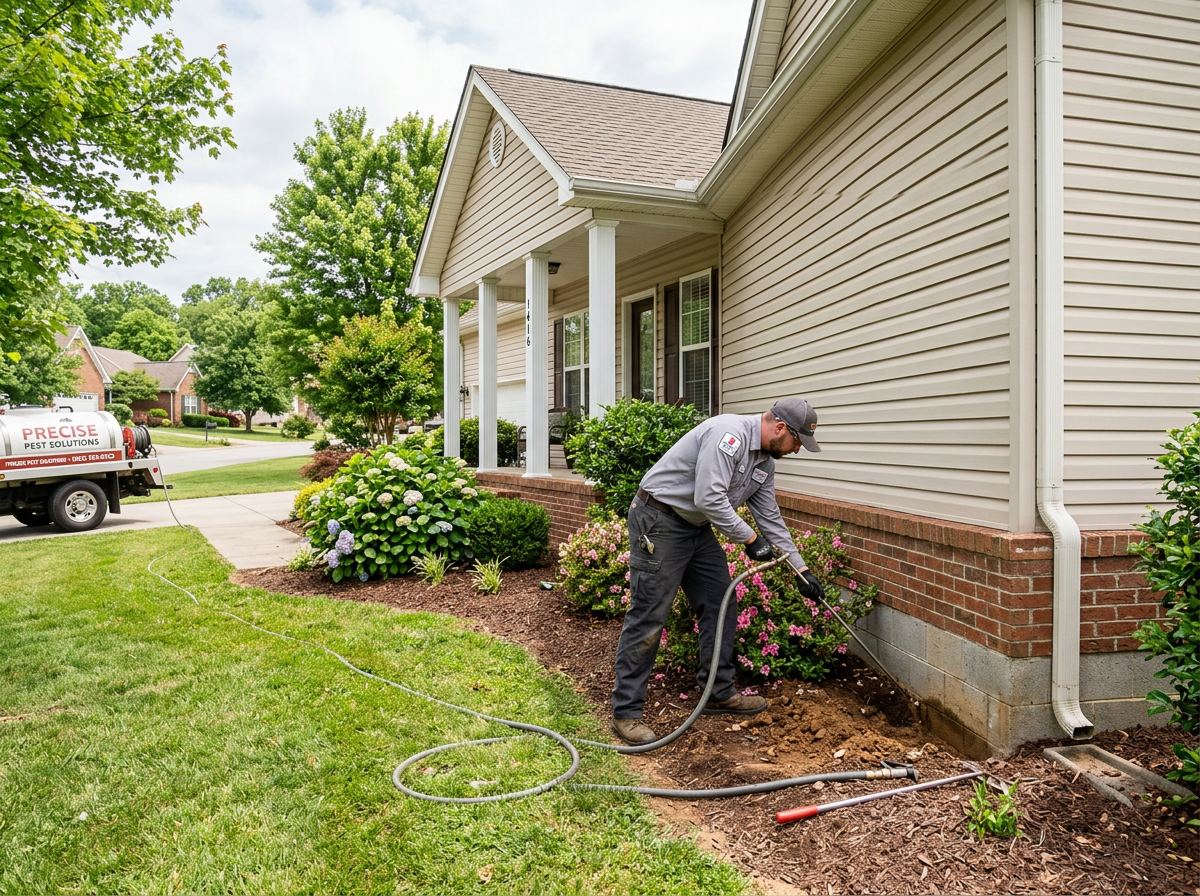
Treatment begins with careful inspection for mud tubes along piers and foundation walls followed by trenching around the exterior perimeter and rodding beneath attached slabs and porches to place liquid termiticide where termites travel. In split-level layouts common in Eagleton Village and Wildwood crews also drill through concrete at expansion joints and utility entry points to reach soil under the slab. Vapor barriers and improved drainage around the foundation reduce future moisture that would otherwise weaken the treated zone.
Because these older brick ranches often have limited access under porches and decks the work focuses on creating an unbroken barrier rather than spot treatments. Monitoring visits after the initial application check for any new activity near treated areas before the next swarm season arrives. The same methods apply to pre-construction soil treatment on new builds in Alcoa and Loudon County where the red clay requires thorough coverage before footings are poured.
Technician insight
In Maryville the thing that catches most people out with Liquid Termite Barrier is how the red clay shrinks and cracks during dry spells, opening new paths under the slab that the original treatment never reached. Homes from the 1970s in the Wildwood area often have porch additions poured right over old grade beams, so you have to drill extra holes at the seam or the termites simply walk around the treated soil.
Crawl Space Entry on a 1978 Split-Level
Mud tubes ran up several piers in a vented crawl space under a brick split-level near Downtown Maryville. Trenching around the perimeter and rodding under the attached slab closed the main travel routes. Follow-up checks showed no new activity before the next spring swarm season.
Liquid Termite Barrier Services We Offer
✓Perimeter Trenching Treatment
A narrow trench is dug along the exterior foundation walls and backfilled with liquid termiticide to create a treated soil zone that intercepts termite tunnels before they reach sill plates.
✓Crawl Space Rodding
Long rods inject termiticide into the soil beneath vented crawl spaces common in Maryville brick ranches where wood piers sit directly on grade.
✓Slab Drilling and Injection
Small holes are drilled through concrete slabs at porches and garage entries so termiticide can be placed under the slab where termites travel along utility lines.
✓Porch and Patio Barrier Application
Treatment extends under attached concrete porches and patios by drilling or trenching at the edges to close gaps that often allow entry into adjacent living areas.
✓Pre-Construction Soil Treatment
Liquid termiticide is applied to soil before footings and slabs are poured on new homes in Blount County to establish an initial barrier layer.
How it works
- 1
Site Inspection
Technicians examine the crawl space, foundation walls and any visible wood-to-soil contact points for mud tubes and moisture issues.
- 2
Trench and Rod Preparation
Exterior soil is trenched along the foundation and access points under slabs are identified for rodding or drilling.
- 3
Termiticide Placement
Liquid termiticide is applied by rodding and trenching to form a continuous treated zone around the structure.
- 4
Post-Treatment Check
Follow-up visits confirm the barrier remains intact and check for any new signs of activity near treated areas.